Showing posts with label Patagonia. Show all posts

23 July 2017

In Patagonia

It was tree-less, grey-green thornscrub for as far as you could see. There was no shade and the wind was relentless. The gusts blew my bike out into the road. I had ridden all day in my lowest gear. In 12 hours, I had covered 80 kilometers.

I passed a shrine to Gauchito Gil and then a sign for “Agro Tourism,” and I turned off onto a one-track dirt road that led back to an estancia. In front of a white farmhouse shielded by poplars a man sat at a table drinking mate. I had not seen anyone in three days.

“¿Qué tal?”

“The wind is strong. The wind has defeated me today,” I said.

“This wind is nothing,” said the man. “In the Land of Fire is the strong wind. La Escoba de Dios. The Broom of God, they call it.”

His name was Guido and I asked about food and water and a place to put up my tent. Did I also want to go horseback-riding, or to fish at the coast? Did I want to hunt guanaco? I told him I was too fatigued for those activities and we came to an agreement that for 100 pesos I would put up my tent and have an asado of mutton for dinner, then breakfast in the morning.

Guido showed me a place along the poplars to put the tent, and as I started to put it up, he whistled and called for “Samantha.” A guanaco came trotting out from the corral. Two sheepdogs barked and nipped at her legs. I had only seen guanaco from a distance on the pampas. They were like deer with bulging black eyes. As the guanaco neared, Guido quickly turned his back to it. The guanaco sniffed at his hair and his neck, and then it rubbed its nose on his back. 

"You must not look at the eyes of Samantha," Guido warned me. “If you look at the eyes, she will [something] on you.”

I looked away. But I did not understand the verb. I asked Guido to repeat it, but I still didn’t understand.

Guido tried in English, “You look at the eyes, she put a spell on you.”

“A spell?”

“A spell. Yes.”

Whether or not I respected the dark power of certain animals to cast spells, I saw the seriousness with which Guido turned his back to the creature, and so when she came for me I quickly turned away. I felt her at my back and then her breathing upon my neck. I reached behind and touched her fur. I wanted to be friendly. I didn’t want her practicing any witchcraft upon me. She pulled out a mouthful of hair from the back of my head and I jumped forward.

Guido laughed. “Cuidate. If she [something] on you, it will take four baths to remove the smell. The saliva is dark and very terrible.”

I realized Guido had been trying to say that Samantha would spit at you if looked directly in the eyes. There was no sorcery involved. He had confused the English words “spell” and “spit.”

I went back to putting up the tent, but Samantha continued to harass me. Being unable to turn and face her, she would trot up behind me and pluck out my hair. It was all very funny for Guido.

When the tent was up, we went behind the farmhouse where the peon was butchering a sheep for the asado. He stretched the carcass on an iron spit and staked it above the fire. A dog chewed on a purpled bunch of intestines in the dust. Guido and I drank cups of rainwater from a barrel.

"Do you not fear camping?"

“What is to fear?”

“Do you not fear the Mapuche?”

“What is the Mapuche?”

“Indígenas. They come with a knife in the night. Chorros. Thieves. I do not hire Mapuche. No one hires Mapuche.” He nodded at the peon. “That one is Tehuelche. Only a half-breed.”

Inside the farmhouse, we sat at the dinner table drinking Fernet and cola. It was dark outside and the generator hummed loudly. Samantha looked in through the farmhouse window, her nostrils pressed against the glass. “She looks for you,” said Guido. I thought so too. His wife brought out the heaping plates of mutton-chops with mashed potatoes and a salad of greens and tomatoes. The meat was delicious.

“Do you think more gringos will come here?” Guido asked.

“Maybe. But it is far.”

“In Patagonia everything is far. But there are penguins here.”

"There are penguins in other places too."

The lights flickered and went out. The generator had stopped. It was quiet and his wife lit the candles and we finished eating by candlelight.

“If only they brought us electricity. If only the government brought us running water and telephone lines. More gringos would come then.”

“Maybe.”

“She destroys Argentina, this Kirchner. This one destroys it worse than the husband. Esos chorros roban Patagonia. These thieves steal from Patagonia.”

His wife touched his arm.

“They argue always for who has the true Peronismo. But all are chorros. Thieves. What they do not steal for themselves, they give to the poor. That is the true Peronismo.”

"He is a little drunk."

“And what if I am drunk? Are they not chorros? Do they not steal from Patagonia?”

“Yes, Guido,” she said gently.

“These thieves steal from Patagonia because it is where there is money. But soon they take all the money. Soon there is no more money!” Guido slammed his fist on the table, his glass bouncing off and shattering on the floor. “Putos chorros!” He looked as though about to cry. He stood from the table and left the room. His wife picked up the pieces of broken glass.

“I am tired,” I said finally.

“Yes,” she said. “The wind was strong today.”

I did not see Samantha at the window. I went to the door and opened it carefully and started towards the tent. Then I heard the guanaco behind me in the darkness and I ran. I heard her stumble on something and I quickly unzipped the rain-fly and crawled inside. I heard her outside. She was nibbling on the tent poles.

In the morning, I packed up and loaded the bike. Guido prepared mate for us and apologized for the night before. After all, it has happened before, he said. First the army will remove her. Then the generals will name the towns and streets after themselves. It has happened before many times. Argentina will have more towns and streets named for generals. He was resigned to it.

04 March 2011

Punta Arenas 3 (The Old German)

The old German was working on his second six pack when I sat down with my plate of pasta. He had the empty beer cans set out in front of him.

“The alcohol. No listen, boy. Listen to me, boy. The alcohol, it gives a different--ah, ah--a different position on the life.” The old German held his hands near his stomach and gestured upward. “The alcohol, it gives me fantasies. Fantasies. I have a different feel on everything,” he smiled. “Do you understand, boy?”

I nodded. I didn’t like how he called me boy, but he didn’t mean anything by it. I just wanted to eat quickly and go back to my room.

“But the alcohol here is expensive. It is expensive. I drink a lot of alcohol,” he laughed.

I made sure to sit at the far end of the dining table but I still smelled his breath. When he grunted and exhaled heavily out his nose the smell was worse. At least tonight he had his shoes on and I wasn’t smelling his feet.

“Boy. Listen. I am poor. Very poor. But I hate the work. No, no. I do not like the work. Look, boy. I travel here and I at the end of the world,” he grins and holds his hands out wide. “This is the end of the world.”

“Not quite,” I tell him. “But you’ll be there soon. It is a beautiful place, Ushuaia.”

“I have a woman but she strict. She say do this, do not do this, do this. And she not like my drinking alcohol. But I say this is my life. This is my life,” he pokes at his chest with his index finger. “I gonna go to the bar with me. I say, ‘Me. You wanna go to bar?’ I say, ‘Sure, we go to bar. We go together.’ And we go. Sometimes I going to bar with someone else, but I like going to bar with me.”

“That’s a good attitude.”

“I was once in coma six months. I wake and see the light,” he points to the light above the table, his eyes wide. “But I hate doctors in the white material. White material. White. That is what I see. All white. It’s like the law. The law all black. The--how you say, how you say--” he motions as if striking a gavel.

“Judge.”

“Yes, yes, he in the black. He say 15 years,” the old German holds out his hands as if in handcuffs. “He say 15 years and you go away. He in the black, the doctors in the white. I hate the black and the white. I hate it. That year I go to see the doctors in the white and I go to see the black.”

“What did you do?”

“Ah. Ah. It was nothing,” he waves his hand dismissively. “It was little. I had problem with the alcohol. It does not matter.”

The old German was quiet for awhile and I finished my pasta. I got up to leave.

“Boy, get a beer. Get a beer of mine. I tell you boy, get a beer.”

I thanked him but said I had some work to do on my bike before I left for Santiago.

“But I give you beer, boy?”

I could see it disappointed him but I said goodnight. The old German wanted someone to talk to. From my room I heard it every time he cracked a new can.

My room with bike and gear in boxes

03 March 2011

Punta Arenas 2


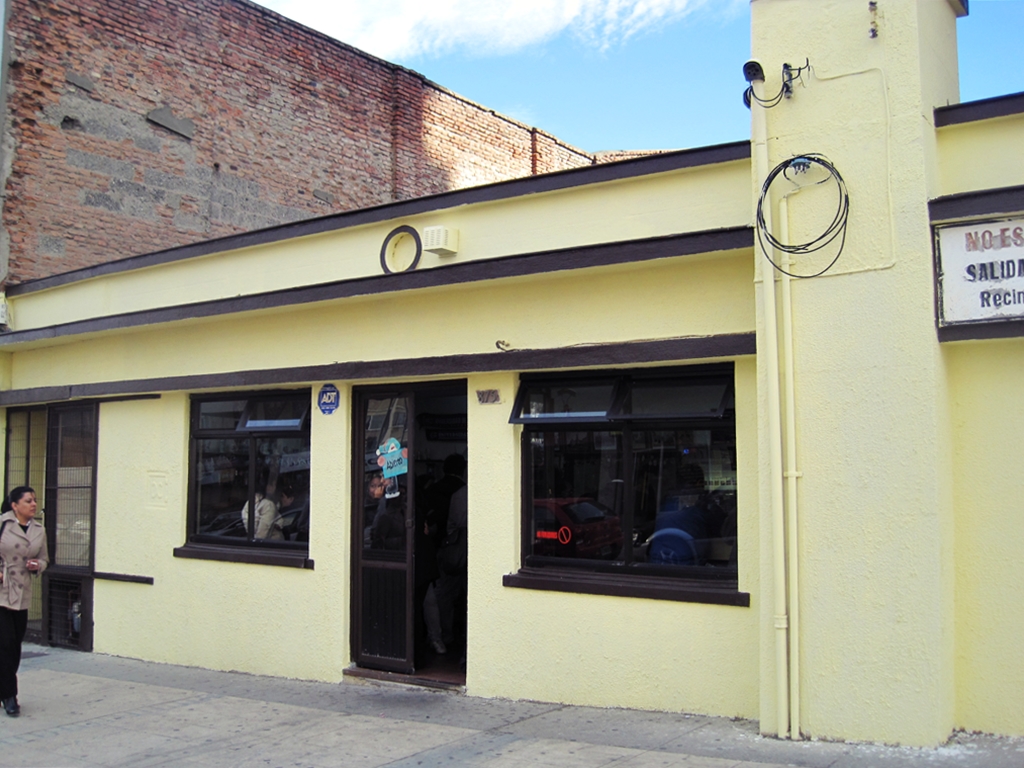
The last two photos are of a tiny, un-signed sandwich shop off the main plaza. Inside is a long counter you can sit at if you are lucky. The shop was packed each time I was there. The menu is posted on the wall and consists of hot "choriqueso" sandwiches and sweet milk. The choriqueso is a sandwich of chorizo sausage crushed into a paste with melted cheese on a small hard roll and they cost less than a dollar US and they are delicious. I sat for awhile on a diner stool at the counter ordering them two at a time as the ladies made them and drinking them down with mediano glasses of sweet milk. There are four old ladies in back that make the sandwiches and two at the counter that take orders and serve them. The sandwich is something Chile does very well and I have also enjoyed the hot churrasco sandwiches with everything on them (lettuce, tomato, fried egg, and ham). A good sandwich begins with the bread and they have very good breads in this country.

02 March 2011

Punta Arenas

I took a bus from Rio Grande to Punta Arenas. Norma, who runs the Club Nautico, knew of an agent in town that sold tickets at good prices. By taking a bus I figured to save my knees a few days of difficult riding into the wind across the Chilean ripio. From Punta Arenas I had the option of flying to Santiago on a cheap Chilean flight, or looking around the port for a freighter headed to Valparaiso. I picked up two bike boxes at a bicicleteria, cut them down to size, and packed up the bike and gear to leave Rio Grande.

It was a more than six hour bus ride with long stops at both the Argentine and Chilean customs at San Sebastian. The bus was hot and sweaty and dirty and full of European backpackers. It now felt extraordinary to cover such a distance in a single day. I had become used to looking at maps and calculating bicycle distances and to ride to Punta Arenas would have been at least three days on gravel and sand roads and into a brutal headwind.

I thought the bus would make the ferry crossing at Porvenir but instead, after following the coast from Rio Grande, we continued north across the ripio to the ferry at Punta Delgada. I saw again the route it had taken me two days to ride. Commerson's Dolphins followed the ferry across the Strait of Magellan, streaks of black and white in the water and then leaping through the surface and back under. At 5 feet long and 100 lbs these dolphins are some of the world's smallest and because of their coloring are also known as the 'skunk dolphin'. They were exciting to watch. When I had taken this ferry two weeks earlier I had not seen them.

But I could not travel by bus and this one trip was enough. The distances are too long in Argentina and it makes for too many hours sitting and looking out at a landscape that for a passenger must be monotonous. To ride that same landscape though is interesting and exciting, and all the subtle changes of topography appear to the touring cyclist and he experiences them slowly, sometimes very slowly because of the wind, and he enjoys them. Riding on the bus made me long to get back on the bike and it is with renewed enthusiasm that I will approach the Paso Los Libertadores over the Andes between Santiago and Mendoza.

Where we were let out near the centro in Punta Arenas there was a crowd of old ladies handing out fliers for their hostals. I had the name of a hostal that had been recommended to me but I needed a taxi to get there with the two bike boxes and I had no Chilean pesos. A number of backpackers were looking to come with me since they spoke no Spanish and heard me communicating with the old ladies. I made a deal with little, old Veronica that if she would pay for my cab ride to her hostal I would stay there and told the backpackers they were on their own. It was their own fault they showed up on a continent unable to communicate.

Veronica's hostal was actually her home and she had put bunk beds in two of the rooms to function as small dormitories. There was nobody sleeping on the other bed in my room but down the hall in the other room was an old German man. He was sitting at the dining table and by the evidence of the beer cans had been drinking all afternoon. He didn't speak any Spanish and wanted to talk with me and after I put my boxes in my room I sat down with him. The German's english was broken and difficult to understand and he had no shoes on and his feet stunk horribly.

He told me about his life in Germany working illegally in an insulation factory and saving as much money as he could for this trip across the Americas. Working with insulation meant your body itched and the German demonstrated by scratching his chest and arms frantically. Did I understand? Yes. I did. He talked about places he had been in the United States but he had them all mixed up. The German was certain that Tampa Bay was in New York state and that Denver was in Mississippi. I tried but was unable to convince him otherwise. The smell of his feet became too intense and I excused myself and went to bed early. I was fortunate not to be sharing a room with him. 

27 February 2011

Back to Rio Grande

I left Tolhuin early and it was cloudy and windless. It was Sunday morning and there was little traffic along Ruta 3. There were the climbs through the smaller mountains that I remembered and the forests of twisted trees and I passed the spot where I had stopped a week earlier to eat lunch with the Canadians. A few tour buses passed me and I wondered if they were on one of them, their bikes in the luggage hold, catching a glimpse of me riding as they passed. At 50 kilometers a cold wind from the northeast began to blow. It would increase in strength as I neared the Argentine Sea and followed the coast up to Rio Grande.


A cyclist couple from Switzerland stopped and we talked. They were heading to Ushuaia from Bariloche and would fly back to Buenos Aires. As we talked two other cyclists heading south approached and stopped. One was a tall German on a huge, fully-loaded recumbent and the other an Argentine. The group of them marveled at the folding bike and I had to go through my explanations of wheel size and even had to defend the size of tires as being suitable for ripio. The German was convinced that a larger diameter wheel was best for riding on gravel. Discussions of wheel size and gearing are something I have tired of, though it is something anyone riding a Bike Friday should be continually prepared to discuss.


I made Rio Grande around 3pm and had lunch at the YPF petrol station. Then I rode down to the southernmost part of town to the Club Nautico and was happily greeted there by Norma. The place was empty now, she said. In two weeks it would close as a campsite. Everyone I had known had gone during the last week with the changing of the weather. The tourist season for Tierra del Fuego was basically over and I had the place to myself. I put up my tent on the hardwood floor upstairs and took a hot shower to warm up. I looked out over the bay where the Rio Grande met the Argentine Sea. The tide had come in. I made a coffee and sat down to research ways to get to Punta Arenas.

26 February 2011

Back to Tolhuin

The morning I left Ushuaia it was cloudy and cold, very cold. I had arrived on a beautiful sunny day but then the summer seemed to have ended suddenly a few days later. I rode slowly along the port and started back up into the mountains. My legs were heavy and I had no proper warm-up as the climbing began immediately outside the city. I began to get loose at the Paso Garibaldi and climbing the cutbacks up the forested mountain a headwind started to blow and I crawled up the pass, head down, making myself small to the wind. Then at the top I stopped, and looked down across Lago Escondido and beyond Lago Fagnano, and the range of smaller mountains beyond it. Even on a dark, cloudy day it is a beautiful ride from Ushuaia to Tolhuin and I was happy to do it again.


It was mid-afternoon when I arrived at the panaderia La Union in Tolhuin. At the bakery storage warehouse in the room for touring cyclists I met Edgar from Colombia. We talked and he affirmed with great certainty that Colombians were the finest people in South America and that Colombia was the continent’s most beautiful country. It was good to talk to a Colombian and of Colombia, a place that right now was very warm, and it made me start wishing to get back there sooner. It was becoming too cold for me in Patagonia.

Later two other touring cyclists arrived, one from Lithuania, the other northern England. We each examined each other’s bikes and setups and talked about the roads and places we had ridden. I asked Edgar where his panniers were. He had none. The Colombian carried only a single water bottle, a sleeping bag, and a small bag containing a pair of shorts, his tools and a spare tube. He had ridden from Colombia down the Atlantic coast and was now riding back along the Pacific. The Colombian made the three of us with our panniers and tents and other baggage seem ridiculous.

The Lithuanian and Englishman had been riding together and had come through Punta Arenas and across the Chilean ripio to Rio Grande using a different provincial route than the one I was planning to ride. They encouraged me to go this longer route. The ripio was very good on the Chilean side, they said, and there was a colony of King Penguins along the Bahia Inutil you could reach by leaving your bike at the roadside and crossing a stream and a long field. The problems with the route would be the additional 150km I would need to ride (bringing the total to over 300km), the absence of towns between Rio Grande and Punta Arenas, and that I would be riding into the wind the entire way. The Lithuanian and Englishman had had the wind at their backs blowing them across the ripio. The weather forecasts for the coming week indicated rain and heavy winds across Tierra del Fuego. I would need to make a decision when I arrived at Rio Grande.

25 February 2011

Leaving Ushuaia

The problem with Ushuaia is leaving. Ruta 3 is the only road in and out and if you have come by bicycle you will need to ride at least 300 kilometers back the way you came. To leave Tierra del Fuego from Rio Grande is at least another 200 kilometers, much of it across ripio through Chile. The fall weather has come suddenly and with it very uncertain winds and rain across the island. To go north and west will mean riding directly into a powerful wind.

I want to go to Mendoza but a flight there from Ushuaia would cost more than $700. The cheapest way to get north is through Punta Arenas. It is a large and active shipping port and I will first try to find a cargo boat to take me up the Chilean coast to Valparaiso, Chile. Should that not work out there are flights for under $200 from Punta Arenas to Santiago. From Santiago I will cycle over the Andes, back into Argentina and down into Mendoza. I will miss the vendimia--the wine festival--but it is still warm in the north and in Mendoza it does not rain. But I must first get to Punta Arenas. I leave tomorrow.

24 February 2011

Ushuaia 4


23 February 2011

Ushuaia 3 (Maxim)

                        Maxim Olegovich Morozov

The upstairs of the lodge looked down over the city to the port and in the west there were jagged mountains, some snow-covered. Across the Beagle Channel we could see the mountains that protected the harbor and they shown brightly in the sun. I was sitting with the Swede from Gothenberg at one of the stained wooden tables and we were drinking beer. A tall, thin guy with a long beard that I had seen around the campground sits down at the table beside ours. He leans over and asks in a thick accent where we are from.

“Where I am from does not exist,” he tells us.

“What are you?”

“I am Russian.”

“But Russia exists,” the Swede says.

“Where I am from does not exist. I am from Tashkent.”

“That is Uzbekistan. You are an Uzbek.”

“I am Russian," he says. "The muslims have taken Tashkent. But it was Russia and in the years ‘86 to’88 Tashkent was the greatest city in the world.”

“Where do you live now,” I ask him.

“I live in a tent on that hill over there.”

“We are neighbors then," I say. "I live there too.”

“How old are you?” the Russian asks me.

“How old do you think.”

“I think 44.”

I smiled. “How old are you?”

“You guess.”

“29.”

“You are right. But I will not be 29 anymore.”

“It will be your birthday?”

“No, not really.”

The Swede laughs. “How will you turn 30 then?”

“You only have one birthday. Think about it.”

“What are you doing here?” asks the Swede.

“I am looking for a wife.”

“Here in Ushuaia?”

“I am looking here, but also other places. I am looking for two things. She must not live in a city.”

“What’s the other thing?”

“She must be a virgin.”

“How will you know that?”

“I will know.”

“How will you be sure? Sometimes you cannot be completely sure.”

“I will take her when she is thirteen.”

The Swede laughs.

“I will grow her up.”

“There is only one thing better than a thirteen year old girl,” says the Russian.

“What’s that?”

“A twelve year old girl.”

The Swede is still laughing.

“I will take her to live in the forest in Siberia. We will have nine children. That is the number Russian women gave birth to a century before. She will give birth to them in the home. Hospitals rush the birth and make women not want more children. Before only prostitutes gave birth in hospitals.”

The Russian goes on to tell us that he is a priest but he is learning to become a warrior. He tells me that he thinks that I am mostly a warrior. The Swede is neither priest nor warrior. Vlad the Impaler was also a warrior, he says. He was in constant war with everyone and slept outside the royal palace on the grass. He won every battle until they ambushed him and cut his throat, cut off his head and drank wine from his warm skull. I think it’s a compliment to be a warrior, but I don’t question him further.

The Russian has a bag next to him and as he’s talking he takes two long purple potatoes, three jalapeno peppers, and a cup of yogurt and arranges them on a napkin.

“I eat uncooked vegetables,” he says. “I do not eat meat and I do not eat mushrooms. Once I lived on uncooked corn for 3 months. But I lost 28 kilos. I had to stop and to eat dairy. It frightened me. I was very scared. I eat dairy now but slowly I will eat less.”

The Russian takes a clove of garlic from the bag.

“Garlic is a cure, it is not a food. I can clean the lungs by chewing and by breathing. If I am cut I rub the garlic on the wound to clean it. If I begin to be sick I will eat it. It is not a food.”

He produces an onion from the bag and continues, “The cheapest source of vitamin C is onions. That is how we survive, we Russians. Onions. That is not a food too. If you use everyday it does not make sense.”

The Russian holds up a green jalapeno pepper. “This I use to expand my diaphragm. It is not a food too. I like the experience when you eat a pepper and you just explode. You have been a normal guy, and now you don’t know what to do,” he smiles broadly. “Tomorrow I will not eat on the bus. It is 14 hours. If I eat the immune system will be needed to digest the badness in the food and it will not protect me from the germs. If you could practice my breathing exercises you would not need to eat so much. But you must have a pure conscience to practice my breathing exercises. Without a pure conscience you would die.”

The Russian stops talking to eat. The Swede and I are quiet. A strong wind is blowing through the trees from the southwest and I see storm clouds covering the mountains beyond the channel. It's raining hard in the mountains and soon the rain is at the campground, pounding against the windows. The Russian has finished eating his two potatoes and his peppers and yogurt. He stands and addresses us.

“I have to go now,” the Russian says. “But do not forget this. If a good man dies you put a stone. But if a great man dies you must build a hill.”

The Russian turns and pushes through the door of the lodge and goes down the stairs. The Swede and I watch him walk slowly up the hill in the heavy rain.

22 February 2011

Open House

21 February 2011

Ushuaia 2


Beagle Channel from the campground lodge

20 February 2011

Ushuaia

The Italians were gone before I woke and the Canadians were still sleeping when I rode out of Tolhuin. It was windless and bright and cloudless and the sun was hot. It would be 105km into the high mountains to reach Ushuaia.


Lago Fagnano

Ruta 3 ascended and descended gently along Lago Fagnano and then the rode slowly began to ascend and beyond the lake through the valley I could see snow on the far mountains to the south. At 50km into the ride at kilometer marker 3000 I began the 400m climb over the Paso Garibaldi. It was hot climbing the winding road cut into the face of the mountainside, slowly climbing along the little guardrail, the mountain dropping straight down to the lake. It was 15km to the top of the pass and I stopped to look back over the lake. Then it was long, fast descent into the valley between the next range of mountains. I saw a couple of fully loaded cyclists coming the other way up the pass, probably having just begun their tours in Ushuaia.


Lago Escondido

Paso Garibaldi

There was more climbing but I only once needed to drop into my smallest chain ring. It was very busy on the road with tourist buses and cars and camions and off the road in the valleys along the streams there were many people who had stopped to picnic or to camp. All the travelers heading south had been funneled down onto a single road to the last city on the continent.


Monte Olivia


I made one final climb before the city and at the top saw below the port and there were cruise ships in the harbor and mountains behind it. I rode into the center of town and stopped at the tourist office for a map and directions to the campground at Club Andino.


It was a very steep climb north up the mountainside to the campground and I was tired and sat down in the bar beside the hot stove and had a coffee. From the window you looked out across the city and the harbor and the mountains that protected it. It was 25 pesos a night to put up a tent and I had a large plate of pasta for dinner. Tomorrow I would walk down to the port and inquire about passage on a freighter to Valparaiso, Chile. Tonight I would go to sleep at the end of the world.
 
 
Copyright © S O U T H