14 February 2011

Laguna Azul

I was up early because of the guy snoring in my room and went to the kitchen and made coffee. It was very cold and raining and from the window of the lodging I watched the wind gusting and blowing the trees over. You will not ride today, smiled the old lady who was cleaning the place. But I will ride, I said. I will not stay here one more day.

Johann came down later and we talked until it was nearly noon. The rain had stopped and it was sunny now but the wind was very strong and very cold. Johann was having his bike delivered to Rio Gallegos that afternoon and he was anxious to get it. I loaded the panniers onto the Bike Friday and said goodbye to him and started off into the winds towards Ruta 3.

There was nothing from Rio Gallegos until a town in Chilean Patagonia and I bought a load of cookies and snacks at a mercado on the edge of town. Where the town ended the wind was devastating. I rode leaning off the side of the saddle into the wind, almost as a motorcycle racer takes a corner, but trying to ride straight. When the gusts didn’t come I almost toppled over onto the shoulder. I was barely moving. It should have been a rest day, I thought to myself.


Ruta 3 shifted so that the wind was a headwind and crosswind. I set simple goals for myself. Go 6 kilometers and stop and eat some cookies and have some water. The 65km to the Chilean frontier did not seem possible. Even going 20km did not seem possible in this wind. Those numbers were too big to think about at the speed I was moving. Just do 6km. Just 6. Rest. 6 more. Its only 6. C’mon, 6 is nothing. And that was how the day went. As the sun was starting to go down over the small mountains I had gone 50km and began looking for a place to camp.


But there was no protection from the wind. I kept riding and figured if I saw nothing the Argentines or Chileans at the frontier would let me camp behind a wall or a building at the crossing. Then I saw an exit sign for Laguna Azul. It was a tourist spot 4km west off Ruta 3. Maybe I could camp there. At least I would be off the busy main route.

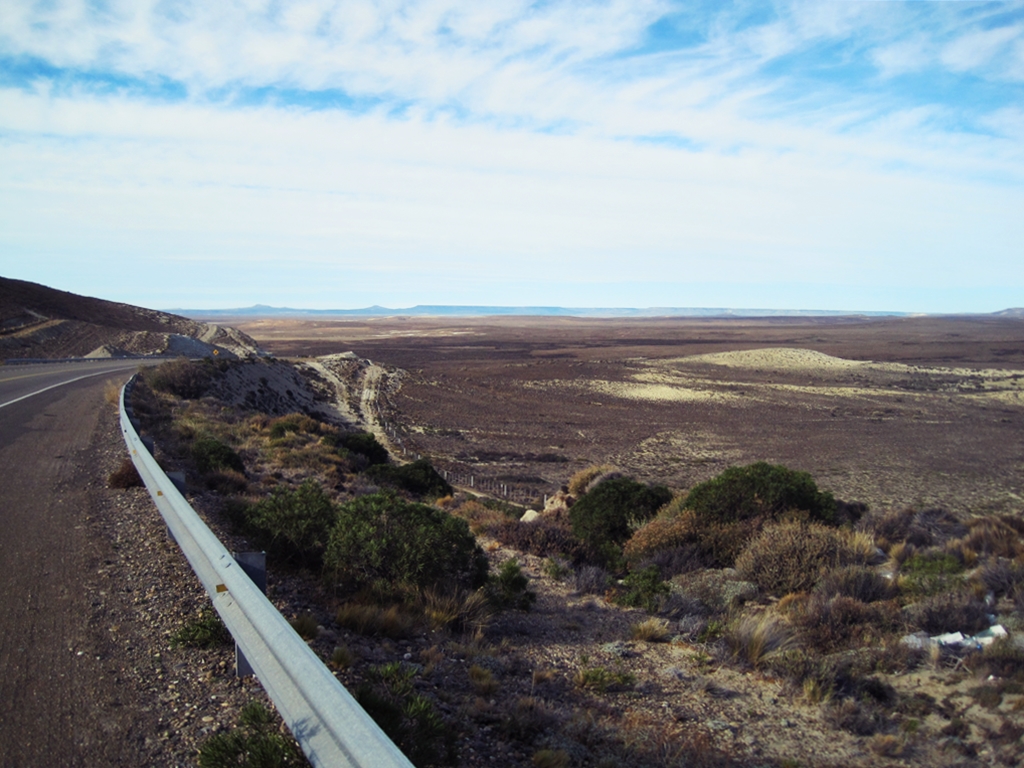
The road was paved toward the Laguna Azul and the fields here were strewn with pieces of lava and in the distance were black mountains. The last kilometer was gravel ascending into the sun setting over the far hills, the wind beating back at me fiercely. I almost could not go further but I saw there were two cars parked on a hill and a cinder path that ran up it and I rode there and laid the bike down and walked up.


The hilltop was the edge of a large volcanic crater and far down below was the Laguna Azul. The Blue Lagoon. It sounded even better in English. It was poetry. I walked further around the edge of the crater and met a Swiss couple huddled around a nook in the lava. On a little stove they were cooking their last vegetables before crossing the border into Chile. You couldn’t cross with fruit or dairy either and they gave me a banana and some cheese dip.


I realized I was getting chilled walking around the lagoon in my sweaty clothes in the cold and wind. I had forgotten to change into dry clothes and didn’t even have my tent up. I hurried back to the bike and pushed it near the crater edge between two lava formations that blocked the wind. I quickly pitched the tent and got inside and changed, but it was too late and I was freezing. I wrapped clothes around me and balled up inside the sleeping bag. I was hungry but that could wait. I needed to get warm first.

I had pasta I wanted to make for dinner but didn’t want to spend so much time outside the tent cooking. I made a bowl of soup instead and ate some cookies and an apple. It had taken a few hours but I could feel my body temperature warming. It would be cold every day now and I had to be more aware of getting out of sweaty clothing before I became chilled.


I was still hungry and ate a box of crackers with the cheese dip of the Swiss couple. It was dark and I was the only one up there on the crater’s edge above the lagoon. The wind had stopped blowing and it was silent and peaceful. Through the tent window I could see the Southern Cross. In the distance I heard the baying of sheep. Then I was asleep.

13 February 2011

Rio Gallegos

I awoke in the night after the storms passed and went out of the tent to relieve myself. It was still and cloudless and I looked up at the foreign stars awhile. There was something just like what we called the Milky Way. I wondered what they called theirs. The moon was bright and I could see clearly over the hills. I was wearing two tshirts and my sweater and a tshirt wrapped around my neck as a scarf, but it was still cold and I crawled back into the tent and went back to sleep.

The wind was cold and blowing hard from the west when I awoke. I would have less than 10km through the hills fighting the wind, and then the road bent eastward and I would have 33km of windblown riding into Rio Gallegos. It was exactly what I had hoped for the day before and the reason I had not started this stretch yesterday when the wind was blowing from the sea.

After winding through the hills Ruta 3 dropped and it was a fast run-out to the lower plain. There the road turned eastward at a place called Güer Aike and traffic was backed up at a police checkpoint. They stopped me too and I needed to show my passport.

The wind was blowing from directly behind me now and I up-shifted to my highest gear, mashing it hard. To my right the yellow brown plain extended to the south and on my left were the cliffs of the broken plain I had just descended from. I was riding so hard traffic was only slowly passing me now and though it was rolling country it was the fastest I had ever ridden not descending from mountains.

I soon made Rio Gallegos and rode into the center of town and at the tourist office was given a map and a location beyond the edge of town for the campground. I stopped at a pizza place and had a large pie and a Quilmes. I was there awhile and ordered a salad and when that was not enough I ordered another small pizza. There was a free concert going on in a parking lot beside the plaza and I pushed the bike over and watched two of the young rock bands.

It was getting dark and I went in search of the campground. It began to rain as I rode to the southern part of town. I was near the bus station and it was a beat-up area and down a muddy gravel road with deep potholes and puddled water there was supposed to be the campground. I didn't see it anywhere. Dogs barked and chased out after me from the shadows. I couldn’t out ride on the gravel and when I saw them coming I got off my bike and would pick up a rock. That usually stopped them, but some still charged and I had to throw at them. These dogs must have been hit by rocks before and a rock thrown near them turned them around quickly and they pulled back but continued to bark.

It was fully dark and I gave looking for the campground. I had the address of a hospedaje and rode through the dark streets with a handful of rocks-- dogs around every corner-- until I found it. It was 60 pesos for a shared room and I would have to lock the bike up outside. I had little choice and paid for the bed. I had wanted a rest day in Rio Gallegos but decided then I would leave the next day. I didn’t like the hospedaje, the town, or all the dogs.

Sleeping in the bunk beneath me was a Dutch guy named Johann. He lived in South Africa and was traveling Patagonia and planned to do some mountain biking. We talked roads and bikes for awhile and he was a fine fellow. His life had taken a difficult turn and he had come to Patagonia to figure things out. Patagonia was a good place for that. I made coffee and we talked until they closed the kitchen and turned the lights out at midnight.

I did not sleep well. There was a couple in the other two beds in the room and the man snored loudly through the night. I kept thinking the snoring would wake her and she would nudge him. But she didn't and maybe she was used to it. I didn’t like Rio Gallegos at all.

12 February 2011

On Ruta 3 (40 km to Rio Gallegos)

The cold wind that was blowing when I went to sleep must have blown itself out overnight and it was calm and peaceful when I awoke. It was cool and the clouds above the hills in the east were bright pink and purple as the sun came up behind them. I made a coffee and then packed and got on the road.


When it is windless Patagonia comes to life. Birds and insects come out from their hiding places and it is no longer a silent, empty place where only the wind blows. The birds darted low across the road feeding and there were also many guanaco and rhea and for the first time I saw a Patagonian fox. The grasses and scrub along the road is a feeding area for the wild animals as they do not compete here for food with the sheep and cattle that graze within the fenced in estancia lands.


I saw another sign for Lemarchand and then I saw the red building on the plain that was the restaurant, hotel and gas station. I stopped and had four sandwiches and a coffee and recharged my computer battery. The day was still windless and I did not want to stop for too long.


I was riding hard and felt good in the saddle and to ride without the wind was easy. There were no longer any kilometer markers and I dropped into and out of smaller riverbeds and I forgot about the distance and and even where I was going. I saw the land and the road and there was only the motion of the pedals. If it were not for water, food, sleep and darkness there would be no reason to stop riding.


By afternoon the sun had burned off the cloud cover and it was hot and I stopped to remove my sweater and leggings. There had been a squeaking sound coming from somewhere on the bike and I saw one of the rear fender stays was rubbing against the wheel. I readjusted it but now the fender was touching the wheel. Since the day on the ripio that I had lost the plastic nut that held the stay to the fender, I had not been able to get it re-mounted right.


I rode further but the fender again began to touch the wheel and made a rumbling sound. I stopped and this time pulled a plastic nut off the front fender and moved it to the back, now duct taping the front fender stay in place. But this failed too and I soon pulled off again. All this stopping was ruining my rhythm and it made me furious and I removed the fender from the bike and lashed it to the back rack. Had it been biodegradable I would have tossed it on the roadside.


Now I was riding without any noise and I got back into rhythm and began to push it. I saw a sign indicating 80km to Rio Gallegos and I began to think I might do the whole 170 in a day. But a slight breeze soon began from the east and it quickly developed into a gusting headwind and crosswind. I felt strong and rode through it but it worsened. I knew that Ruta 3 would soon turn directly eastward towards Rio Gallegos, and the last 33km would be directly into this terrific wind. It was almost 5pm now, and I decided I would ride until I saw a good place to camp. The wind would probably be from the west tomorrow and that last 33km would be easy. 

There was a bend in the road through the hills and a steep drop off and I stopped to inspect it and saw that I could camp below and be unseen from the road. I pushed the bike down the embankment and pitched the tent and lay inside and watched the sheep grazing on the hills.

The wind died down and I went out and started to cook some rice. The skies had gone grey and there were dark, nasty clouds moving in quickly from the west. The wind picked up and I put on the rain fly. It had become a race between the cooking rice and the rain.


The rice finished cooking just as the first drops fell and I got back into my tent and began to eat. The sky went black and the wind and rain battered the tent, bending it severely when it gusted. I finished eating and lay in my sleeping bag watching the tent bend and shake and wondering if it would hold. The storm only worsened and rain began to leak through the rain fly and when it gusted water hit me. I packed up the panniers and readied my rain gear beside me. If the tent went down I could evacuate it quickly. I fell asleep with my rain jacket over my face. It was easier to sleep when you had a plan for when it all went wrong.

11 February 2011

On Ruta 3 (170 km to Rio Gallegos)

I packed up at dawn and left the river. I climbed through the cliffs out from the Rio Chico riverbed and up onto the flat of the plain. Ruta 3 turned westward into a light breeze and by late morning it had become a strong headwind. The sun was hot and I knew despite the wind that it was going to be a very hot day.


I could see another range of small mountains, blue and distant, on the horizon. As I got closer the road dropped and I descended into a huge headwind towards the Rio Santa Cruz. The riverbed was wide and flat and along the Santa Cruz it was very green and further west downriver I saw the town of Piedra Buena. Passing camions made the winds swirl and pushed the bike all over the road and it was slow, difficult riding. Piedra Buena looked bright and clean and there were many political advertisements along the road. The local politicians were allying themselves with the dead Nestor Kirchner and with his wife and advertised themselves as the true Peronistas.

I struggled down the descent and stopped at the petrol station outside of town. It was very busy and there were long lines of cars waiting for the pumps. I ate breakfast inside and then went and unrolled my ground pad under the shade of a tree and took a nap. I awoke to the chattering of a group of Asians who had come off a tour bus. The mountains at El Calafate and the Perito Moreno Glacier were about 250km west of here.

I went back into the service station and purchased 14 liters of water and 8 packages of cookies and snacks. Rio Gallegos was 240km away and it would be my longest ride between supply stops. I had read that most touring cyclists abandoned along this stretch due to fatigue, lack of water, and even boredom. A group had gathered and watched me as I poured water into my water bladders and repacked the panniers. I had strapped two more 2 liter bottles to the back rack bringing my water total to over 16 liters. Along with the food this was as loaded as I had ever ridden. As I started out of the service station it felt as if I were pedaling a motorcycle.

Rio Santa Cruz

I crossed the bridge over the Santa Cruz and started the climb out of the riverbed. I was heading eastward now and the wind was mostly behind me and climbing was easy. Back up on the plain Ruta 3 turned back westward and into a range of short mountains around Monte Leon and the riding was back into the wind and very slow and very difficult.

Because of the heat and the climbing into the wind I was consuming much water and stopped after every couple of climbs to rest. I knew at the turn off for Ruta 9 to Calafate the road would bend back eastward and I would have the wind more or less behind me. It was a long 40km into the wind until then and when I made the intersection with Ruta 9 I was at 90km on the day and I stopped to eat and take a nap.


I laid on my ground pad in the shade of a road sign and ate an apple. Ruta 9 was behind me and it was all dusty ripio. It was 245km to El Calafate, and entirely into the wind. Before coming to Argentina I had plans to ride it. But now after my experiences with the wind and ripio and lack of supply stops, I was no longer interested. It probably could be done but I was not the one to try it.

When I woke up from my nap I felt good in the saddle and put in another 30km bringing me to 120km on the day. I had seen signs for a place called Lemarchand that indicated there was gas and food and a hotel there, but it was still another 50km and not being on my map I did not want to count on it.

The winds picked up and then the fatigue hit me and I began looking for somewhere to camp. Past a place where truckers pulled off, I found a lower lying area off a bend and a deep fence line. I pitched the tent so that only a trucker from the height of his cab could see the tent if he were looking in that direction. At night I would be entirely unseen from the road.

It was hot and I lay in the tent in just my cycling shorts and waited for the sun to go down. The wind stopped before the sun set and then a cold wind began to blow from off the sea. It became colder still and I had to put on my wool sweater and heavy socks and then later my jeans.


I cooked up a special plate of pasta using a can of tuna along with my spices and it was very tasty. I ate a package of cookies and read some Carver short stories on my computer until the battery died. I had 170km to Rio Gallegos which I could do in 2 days. I had food and water to last at least 3. I felt good about my situation and went to sleep.

10 February 2011

Rio Chico

I was slow to leave Puerto San Julian. I awoke late and made two cups of coffee at the campground before I packed up. Then I washed some clothes and my coffee cup and refilled my water bladders. I had forgotten the day before to purchase and another canister of butane for my cooking stove and went into town looking for it. I begin to carry a fresh backup canister of gas when I know the one I have been using is running low.

The supermarkets did not carry them and nor did the hardware store, but at the end of town there was a sporting goods shop that had camping equipment. They carried the wide model of canister that was specifically designed for my stove but for nearly the same amount of gas it was twice the price of the thin canister. The stove could only connect to the thin canisters with the special adaptor piece I had purchased extra when I bought the stove in Bahia Blanca. I rarely saw anything other than the thin canisters and the adaptor had been a good purchase.


It was 11 o’clock when I left town. It was a hot day, the hottest day since much further north at Punta Tombo, and I rode in a tshirt. There was a light breeze and the road climbed southwest through the rugged mountain area around the town, rising and falling, but always climbing. I was riding inland, back up to the Patagonian plain.


After 30 kilometers I made the last climb and at the top the flat of the plain, all dirt and scrub, stretched out to the horizon. A headwind was blowing but it was not too strong and felt refreshing in the heat. I was drinking more water because of the heat but I knew I would make Piedra Buena either tonight or tomorrow and I would refill my supplies there. After Piedra Buena there was said to be nothing over the 240 kilometer stretch to Rio Gallegos.

Gran Bajo de San Julian

All along the road the guanaco were feeding. They had become accustomed to the presence of vehicles but when I approached their little heads would pick up on their long necks and the group of them would turn and watch me riding slowly towards them. Then one would begin to make a screeching horse-like whinny to alert the others, and he would turn and bound off towards the fence line, the others turning to follow, and each elegantly leaping the fence and bounding across the plain until the leader stopped and they turned to watch me from the new, safer distance.


The rhea too fed near the road but they were harder to see. Often you heard the fluttering of their feathers before you saw them. They looked like minature ostriches and were funny to watch run, the way they scampered off, their legs turning very quickly and their long necks and bodies motionless. The rhea was such a skittish careful bird and, unlike the guanaco, I did not see any rhea dead alongside the road from being struck by motorists.

I took a short nap in the early afternoon in the shade cast by road sign and then got back onto the bike. The wind strengthened later and when I saw a wall of cliffs, blue in the distance, I knew I was getting close to Rio Chico. I dropped into a wide river bed and fought the wind across it. The river was nearer to the far cliffs and my plan was to camp along it.


The Rio Chico was gray and milky and running low and I crossed the bridge over it and turned onto a dirt road that ran along the water. There were fisherman working the river from the banks and I rode until the dirt road ended and pushed the bike through the scrub to a secluded spot at a bend in the river. I pitched the tent and lay down inside and listened to the water rippling against the bank.

The wind was really blowing now and I was glad to have finished my day on the bike and staked the tent down. I climbed down the steep river bank and washed my cycling shorts and tshirt but I would have to wait until the sun went down, and the wind hopefully stopped, before I would do any cooking.


It was after 10pm when the wind stopped. I was ready with my cooking setup and had the water boiling for a bowl of pasta soon after. It was quiet now, the night sky clear and I had not put up the rain fly so that I could look up at the stars. I finished eating and lay back and studied the sky. It still amazed me to see constellations I had not seen before and though I could identify the Southern Cross, I planned one day to know more of them. I closed my eyes and listened to the river, and then I was asleep.

09 February 2011

Puerto San Julian 2


08 February 2011

Puerto San Julian

I opened my eyes and did not hear the wind. The light was just beginning to show through the tent walls. I packed up the panniers, one in each corner of the tent, its contents spread out directly in front of it. I had a system for where things were distributed in the tent and I could pack the panniers and the tent, load the bike, and be on the road in 10 minutes. Putting a pannier in each corner also helped to stabilize the tent when it was windy.

It was a fine morning, cloudless and silent and not so cold and I needed only to wear my wool sweater. I could feel that later it would be hot and that I would ride in only a tshirt. The thought of the wind appearing, maybe a headwind, motivated me and after a 15 kilometer warm-up I began to really turn it in a high gear of the large chain ring.

It was flat and fast and I was eating kilometers and I began to have thoughts of Puerto San Julian. The name was pleasant sounding to me and the town had a long history. The town square was famously the spot where Magellan executed a number of mutineers, one after the other, each in a different and creative way, and the mutiny was put down. Viedma and Darwin would come there later. I imagined the town was clean and bright with cafes and restaurants along the blue waters and sandy beaches of the bay. I imagined myself sitting at the outdoor table of a restaurant and ordering a large Quilmes. Then after watching the people pass on the boardwalk, or the cormorants feeding on the water, I would order another. Another Quilmes would be too much but I would do it anyway.


The plain I was riding broke away and I dropped down sharply, the road fast and winding and I moved down into the drops, up shifted, and fell with the road to sea level. As I descended I could just see the sea beyond the white, dusty valley and in the distance a range of mountains, blue in the distance. But there were big headwinds when I hit the valley. I was getting closer to the town but this last part would be difficult.


By 11 o’clock I stopped at a sign that indicated I was 27 kilometers from the town. The more than 100 kilometer ride could be over by lunchtime. I passed a billboard advertisement for Puerto San Julian and a smaller sign with an arrow reading “Circuito Costera 27km Puerto San Julian”. I knew of a secondary road along the coast but that was said to be ripio. My head was down and I did not even look for the road.

Ruta 3 ascended out of the valley and into the mountains and it was slow going into the wind. And fighting the wind up the passes I began to have doubts. I stopped and got out my map. Ruta 3 did not actually pass through Puerto San Julian. An access road connected Ruta 3 to the town. I had not seen a sign for Puerto San Julian for about 12 kilometers now and began to wonder if I had missed it. The access road was at least 15 kilometers in distance which meant I should have seen it. I was hungry from imagining all the food and beer I would have along the bay, and my mind was probably a bit addled too from not eating a proper dinner the night before. Could that Circuito Costera I passed have been the access road?

I decided to climb further and see if around the next bend there was a road. I reached the top of the turn and looked across the next couple of passes and saw nothing. Ruta 3 seemed to be turning further inland. Clearly I had missed the access road. But that was no big deal. I would have the wind behind me to ride back the 12 kilometers to the access road and I crossed the pavement and headed back.


Coasting down the mountain with the wind at my back I started again to think about sitting at a table in the shade with a 750ml bottle of Quilmes. It was not a great beer but I found the white and powder blue label very attractive and everyone drank it. I would be drinking one very soon. I saw the back of the Puerto San Julian billboard ahead. Yes, it must be the access road.

As I rode closer I looked but did not see asphalt. I saw a gravel and sand path leading off through a fence and into the dusty fields towards the sea. It was ripio. My heart sunk. It could not be the access road. I felt a reaction against turning around and riding the last 12 kilometers a second time, ascending into the wind, to look again for the access road. And maybe this was the access road after all? Maybe this ripio ended beyond the first hill?

I turned onto the ripio. It wasn’t so bad at first. There was a good, hard-packed line in the sand and the rocks were not so large and jagged. Going east the headwind was gone and it felt warmer and I rode over a series of hills until stretching out below me was the sea. Ahead a second road broke off down to a beach of smooth pebbles beneath a huge cliff. It was very impressive coastline.


As I ascended the hills along the coast the ripio worsened into deep holes and sharp, jagged rocks. I realized I must be on the 27km coastal road that was entirely ripio. It could not be the access road. I had already ridden a few kilometers and remembered what the ripio had done to me at Punta Tombo. There would be no cold Quilmes for quite some time if I did not turn back. But I could not ride back to Ruta 3. It was too late for that. That was too much going back. I had water and food and it was written that this stretch of coastal road was very beautiful. The sky was bright blue and cloudless and it was not too hot. It was a wonderful afternoon to ride the ripio. The Quilmes can wait.


There was much ascending in the lowest gears, and the tires slipped and from all the movement in the saddle and I could feel the beginnings of the irritation that results in saddle sores. Tomorrow would be a rest day though, I assured myself. At the top of a long, steep hill was an abandoned lighthouse and down the coast the cliffs fell off into the blue water and further south I could just see Puerto San Julian. It did not look so far away.

I rode another hour and at the top of a hill a sign read “Puerto San Julian 30km”. Aghh. I looked and saw the road stopped following the coast and ran off westward into the foothills. I had ridden well over 100 kilometers now on the day along with an hour of riding on ripio, and I had at least another 30 to go if the distances were correct.


I was disgusted with myself. The access road off Ruta 3 must have been just beyond where I had turned back. I was a fool and now instead of drinking cold beer along the bay I was out on the ripio suffering. Maybe I wouldn’t make it. I guessed I could camp here if I needed to. What a bollocks I had made of it. That was what an Englishman would say. It sure is scenic though, I said aloud sarcastically. A beautiful day.

It would be three more hours of riding before I made Puerto San Julian. There were stretches along the water where the road was large smoothed stones and unrideable, and I had to struggle to push the bike through. A plastic nut that attached a rear fender stay popped off somewhere and was lost and I had to stop and duct tape the metal stay to the plastic fender. I was sweaty, dusty, and tired when I rode onto the asphalt at the edge of town.

Puerto San Julian was a long boulevard of brightly painted shops and houses to the sea. At the end of the boulevard in the water was a black and yellow-trim reconstruction of Magellan’s famous ship. The boardwalk of cafés and restaurants along the bay that I had imagined did not exist and there was much less to the town than I expected. It was after 4pm and the shops were still closed, the main avenue empty. I rode through to the campground and paid 10 pesos for two nights and laid out my ground pad and took a nap.

Before going for dinner I stopped at bank. A woman coming out of the ATM vestibule told me there was no money. There was one other bank in town and it too had no money. There would certainly be no money tomorrow either. There was no paper money in the town. She felt embarrassed that foreigners should have such an experience in her country. But the banks were often without money in Argentina; they were either being robbed or simply ran out of paper money.

I had 200 pesos and figured I would only shop and eat at places that took Visa. There was one gas station on the way to Rio Gallegos where I would need to buy supplies and 200 pesos would be more than enough. But if Rio Gallegos had no money I would need to stay there until more was delivered.

I had a dinner of breaded mozzarella and raviolis and a half bottle of wine at the restaurant of a hotel. The girl continued to refill the breadbasket and I ate 3 baskets of rolls, spreading onto the bread the delicious aioli with bits of ham. It was dark now and I drank a coffee and watched the bike through the window and I felt very full and very happy. The day’s ride was finished and I would rest tomorrow and I was excited to go shopping at the large supermarket I had seen on the way into town.

I rode back to the campground and put up my tent and crawled inside. A young family was grilling at the neighboring spot and the man came to my tent door and called out to me. His name was Marco and he had two large chorizo sandwiches in his hands. They were for me, he grinned. I was stuffed from dinner but I could not turn him down and accepted the sandwiches. Along with the sliced sausage there was tomato and a white sauce and it tasted delicious.

I walked with Marco back to his grill and met his family and he and I talked and passed a large bottle of beer between us as we ate. He was born in Mendoza but they lived in Ushuaia. We talked long enough that his family went to sleep inside their tent and I could feel room opening up in my stomach for the second sandwich. It was one o’clock when I said goodbye to Marco and went back to my tent and fell asleep with a full stomach.

 
 
Copyright © S O U T H