18 April 2011

Salta 3

I abandoned my plan to take the train from Tucuman to Buenos Aires. There seemed no way to purchase a ticket online and it was impossible to purchase one by phone or even to inquire about the availability of tickets. Tickets were supposed to be purchased 2 weeks prior to travel at the ticket office in Tucuman. There was also a report that prices had been raised by 80%. Even more worrisome was the possibility I would have to pay a significant excess baggage fee to get the 2 boxes containing my bike and gear to Buenos Aires. To answer these questions and get a ticket I would have to go to the ticket office in Tucuman. As much as I wanted to travel by train across the Pampas it was too difficult and I decided to travel to Buenos Aires by bus from Salta.

I walked to each of Salta’s bike shops inquiring about boxes. Only one shop had them and a man working there offered to sell me a box for 20 pesos. I told him he was joking. He said he was serious. I offered 10 pesos, not even intending to pay that. He refused and I left the shop.

Walking back through the Plaza 9 de Julio someone called out my name. Sitting at one of the outdoor cafĂ© tables was Jason, an English cyclist I had met in Tierra del Fuego at La Union Panaderia at Tolhuin. I sat down and joined him for a drink. He had just arrived by bus from Buenos Aires. After a few weeks touring Uruguay he had tried to ride cross the Pampas but abandoned due to there being no shoulder on the road, heavy truck traffic, and a lack of places to wild camp. There was nothing to the countryside but flat farmland. It had been my original plan to cross the Pampas from Mendoza and I was glad I hadn't tried it.

Jason had just built up his bike and back at his hostel and, if it was still there, he had a bike box. We talked roads and places we had been since we had last seen each other and I told him about the good riding south of Salta through the Valle de Lerma and the Quebrada de Las Conchas.

We finished our beers and walked back to his hostel and the box was still there. Jason was anxious to get back on the road and my description of the good riding south of the city had excited him. He planned to leave tomorrow on a loop that would take him south to Cafayate and then back north on Ruta 40 towards Bolivia. He planned to cross into Bolivia and continue north and he would contact me in a some months when he made Colombia. If I was still in shape we could do some riding together there.

14 April 2011

Salta 2

 Hostel rooftop

 Rooftop view

 My room on rooftop


13 April 2011

Salta

I slept without the rain fly and it was a cool night and my gear was wet when I awoke. I packed up my panniers and waited until the sun had come up over the mountains so that the tent could dry. It had been my final night of camping in Argentina and today would be my final ride. I packed the tent, loaded the bike, and pushed it through the brush and onto the road.


I stopped at a service station outside La Vina for water and to eat a couple of sandwiches. It was only 80 kilometers to Salta, and I could make it by lunchtime if I wanted. Ruta 68 rose and fell through the Valle de Lerma, through corn fields and farmland between the ranges of mountains. It was clear and warm by late morning and I rode thinking about my last day on the bike here in Argentina and regretting it was over. But there would be other places and I could ride in Colombia if I wanted. Still, Argentina had been a fine country to tour in and I was going to miss it.


The farmland ended 30 kilometers from Salta and there were series of small towns. I stopped in El Carill for lunch and for 30 pesos had a milanesa napolitana with a salad and a 2.5 liter bottle of sparkling water. It was as cheap and delicious a milanesa as I had had in Argentina and when I asked the man who ran the restaurant about another of the meats on the menu he brought out a plate of what was veal for me to try. It was a large piece of veal and very good and I thanked him.


From El Carill the road began to fall and then closer to Salta it descended sharply and there was a long run-out into the city. Then I rode through narrow, heavily trafficked streets with buses and cars and scooters towards the centro. Salta, like other Argentine cities, is made up of one-way streets with few traffic lights or yield signs making it both dangerous and confusing at every intersection and I rode towards the center of town carefully.

At the Oficina de Tourismo I was given directions to a number of cheap hostels and I stopped at a couple before deciding on one further out from the center of town. At this hostel I would have a room to myself on the rooftop and more importantly there was a downstairs storage area to put my bike and where I could work to take it apart, clean and box it for the trip to Buenos Aires and my May flight to Colombia.

12 April 2011

La Vina

I was happy to leave the hostel at Cafayate. The town was pleasant and charming but overrun by European backpackers. The townspeople tolerated these outsiders and the town had changed to accommodate them and their money. I wanted to get back on the road, back into Argentina and away from the tourists.


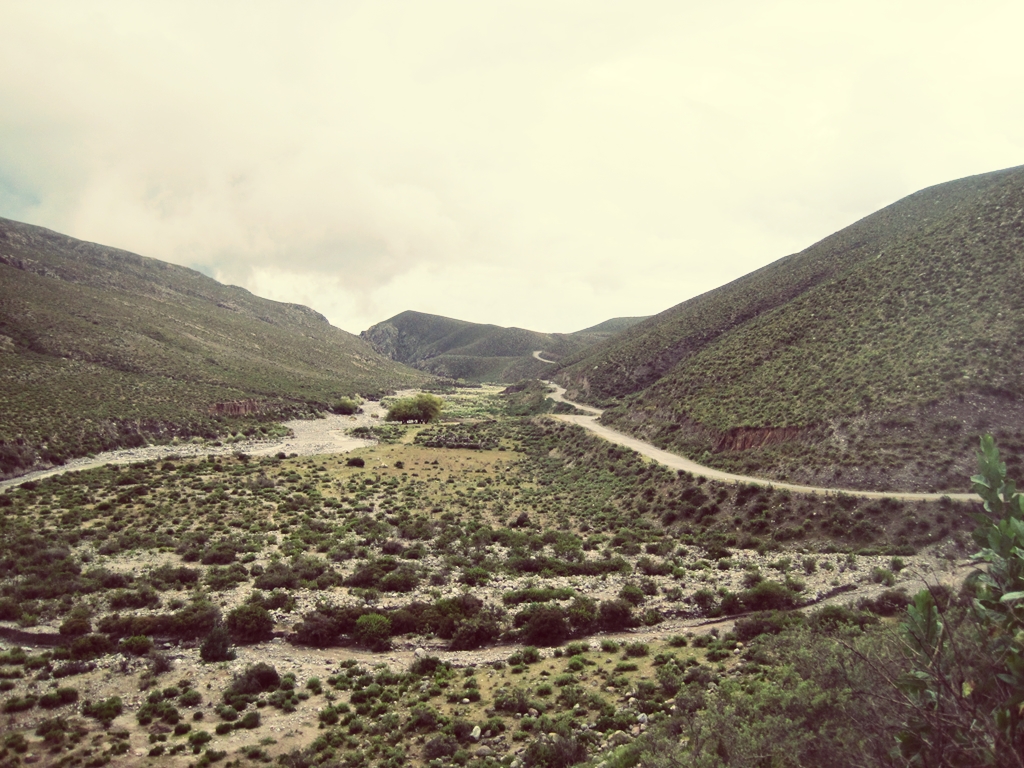
I picked up Ruta 68 outside the town and started north through fields of grapes. Ahead were the mountains and the road climbed up into them and then down to follow a river through the valley. This area along the river is known as the Quebrada de las Conchas and is dry and desert-like, with smooth, mud-like rock formations formed by the river and rain and wind. Ruta 68 would climb up out of the riverbed and then drop back into it through deep red and yellow layers of rock and earth. It was beautiful to ride the winding road through the river valley, and a headwind blew down to cool me.


 El Obelisco


After 70 kilometers the road left the river valley and rose to follow the mountains through the dense forest of the Valle de Lerma. It was cool and humid now and very buggy and I had to ride with my mouth closed and eyes squinted to keep the small bugs out. I passed through small villages and through an area of farmland and just before the pueblo of La Vina I pulled off the road and pushed the bike into the brush and pitched the tent.


I cooked up a plate of pasta with a sauce of fresh tomatoes and onion and drank a cup of coffee. It was a calm, clear night under the stars and I didn’t put on the rain fly. I wanted to look up at the moon and the constellations. I was running out of days on the road and nights camping. This would be one of the last. My journey by bicycle was coming to an end.


10 April 2011

Cafayate 2

I rode past more vineyards on the way to Cafayate and then coming up the road were two touring cyclists. It was a young man and woman and they were Americans. They were finishing up a year long tour that had begun at their home near Seattle. These were the first Americans I had met on bicycles and they said they hadn’t met many either. We talked bikes and roads and about places to sleep in Cafayate and then said goodbye.


Cafayate is a small pueblo with a clean main plaza and streets that run out from each of its four corners. Its not a big town but it exists for the many vineyards around it and also for the western tourists. I could not believe how many gringos had descended upon this small town. I sat in the main plaza drinking a coffee and watched the many white faced backpackers walking among the dark, tawny skinned natives. The natives hardly recognized their presence. The town was a changed place and it was too bad. As pleasant as it was I preferred the untouched places and was already looking to get back on the road.


09 April 2011

Cafayate

It was nearly midday when I left Amaicha del Valle. Ruta 307 descended towards the mountains through desert scrub and a cactus known as the cordone. The road crossed a river and merged with Ruta 40 and I headed north now along the mountain range up the river valley. It was rolling country and the zonda as a headwind kept me cool.


At the pueblo of Quilmes I turned off onto a ripio road up into the foothills to see the Indian ruins. They had been described to me as a miniature Machu Picchu and I rode up the 5 km of dusty, rocky, sometimes washboard ripio to them.


There wasn’t much to Las Ruinas de Quilmes. There were piled stone foundations for buildings that once stood upon the side of the mountain. I walked along the ruins partway up the mountainside before turning back and heading down. I coasted carefully down the ripio and back onto Ruta 40.

Because of the storms in the high mountains deep streams flowed across the low areas of the road. Twice I hit mud while crossing them and was brought to a stop and had to put my foot down into the water, and for much of the day I rode with soaked shoes and wet feet.


Thirty kilometers from Cafayate began La Ruta de Vino with vineyards on both sides of the road. I stopped in at Las Arcas de Tolombon for a degustacion and tour of the winery. They grew only two grapes there, malbec and torrontes, on 31 hectacres of land and though I did not like the malbec I did enjoy the torrontes. It is a white I only rarely drink because of its tendency to taste and smell of gasoline or some type of fuel, but this one was good.


The zonda had picked up now and made the ride through the rolling hills more of a challenge. I passed from Tucuman Province into Salta and rode past more bodegas where tastings and tours were offered but I did not stop. I knew I could make Cafayate before nightfall, but I wanted to wild camp near the pueblo and to ride in tomorrow morning.


I passed some wild horses grazing along the road and pushed the bike back in through an old quarry and up onto a raised area overlooking the valley. It was rocky with scrub and cactus, the mountains behind, but I found a small sandy space and pitched the tent there. I laid down and realized there was a large rock under the middle of the tent. The ground was hardly flat either. But I didn’t feel like packing up and moving the tent. I hadn’t seen anything better anyway.

I cooked up a plate of pasta and lay in the tent doing some writing. The sun dropped behind the mountains and it was dark and I felt sleepy. Then I heard things moving outside the tent. I listened carefully. It was the wild horses I had seen along the road. They had come to feed. I tried to ignore them but in they darkness they would stumble on the rocks and made quite a bit of noise. I unzipped the tent and got out with my flashlight and I scared the dark one off. There was a white horse who just looked at me. He took a couple of awkward steps and I saw that he was partly crippled. I got back in the tent and tried to go to sleep.

I awoke to the sound of chewing. The horses were right next to the tent. I lay quietly. Had horses ever trampled a man laying inside a tent? I didn’t know. I didn’t want to frighten them and lay there listening to them chew, clomp about a little, and begin chewing again. There was maybe a third horse now too. The chewing was very loud and I felt very exposed to be laying below them.

I didn’t sleep for hours. They must have eaten up all the grasses around the tent before slowing moving on back through the scrub towards the road. It was an uncomfortable night with the horses, the unlevel ground and the rock underneath the tent at about the middle of my back. I didn’t wake up feeling very good at all.

08 April 2011

Amaicha del Valle

It was cool but sunny when I awoke. I found a black dog curled up and shivering outside my tent and underneath the rain fly. He must have crawled under during the storms. The tent floor was soaked through where I slept and my panniers set. The ground pad was like a soaked sponge underneath it, and after taking down the tent I draped it and the tent and rain fly over some rocks to dry. It was too humid to dry them completely and I had to again pack the tent damp. I loaded the bike and left the campground and the black dog followed me into town. He must have felt he owed me for providing him shelter from the rain.


I stopped and ate some empanadas before getting on the road. The black dog waited beside my bike outside and then he ran alongside me as I started the climb out of town into the higher mountains. There was little time to warm up as the grade was very steep and I was turning my lowest gear up the switchbacks, Tafi del Valle and the lake further and further below me as I climbed. The black dog was gone now and though the sun was out it was colder and still very humid.


There were clouds higher and the road climbed up into them and the sun was gone. It was so cold now I put on my thermal layer, sweater and leggings and when it began to rain I put on my rain gear. The asphalt ended and the road turned to mud and I could hardly turn the bike through it. It was a cold, wet, miserable climb up a dirt road through the clouds.


A drunken man walking along the road waved me down and told me there was another 10 km of climbing left, but I didn’t believe him. I could see beyond the next rise that the clouds broke and when I got there the descent began. There was asphalt again but it was of terrible quality with potholes and filled-in patches that made it as bad as ripio to ride on. The descent was steep and tricky and very technical because of the road surface and I braked hard to keep my speed down, the road jarring and rattling the bike and I worried my panniers would be thrown off the racks.


But the bike and panniers held and I was now descending above a river. Then after a small climb I could see down into the valley where the sun was shining and I could see the town of Amaicha del Valle. Behind me were black clouds coming down from where I had been and as I descended the rain was just behind me and then out into the valley I was again in the sun and it was warm.


There was a fully loaded cyclist coming up the road and I pulled over and we talked. He was Argentine and was riding from Salta back to his home in Tucuman and he asked me about the weather. Was it raining? I pointed to the black clouds I had raced down the mountain. It was going to be real bad up there.

“You have been to the Little Hell?” he asked.

I didn’t know what he was talking about.

“The top of the pass is called the Infiernito.”

“Then I have been there,” I said. It was a little hell up there too, cold and wet and terrible roads. That was the best description for it.

The Argentine rode a 1999 Swedish Crescent painted in the beautiful Molteni orange I have always loved on a bike and he was very impressed that I knew about and admired the Crescent. It impressed me that he knew Bike Fridays. He recommended a hostel in Amaicha and we said goodbye and I wished him luck. The Little Hell was going to be a lot worse for him than it was for me.

The tourist office was closed in Amaicha and I stopped at a cafe in the main plaza and asked two young guys about the hostel. It was just up the gravel road they said. For 20 pesos I put my tent up on the dirt porch and had full use of the kitchen, internet and bathroom. I prefer sleeping inside my tent to a stranger’s bed and when I saw the hostel was constructed of mud brick in which the Chagas bug often lives I was even more satisfied to sleep outside on the porch. I didn’t want to take any chances with contracting that debilitating and incurable illness that had afflicted Darwin all his later life.


Also staying at the hostel was a young German couple who were stuck in the pueblo because the one cash machine in town had no money until at least Wednesday. There was also a Slovenian girl from Ljublana who walked around the hostel juggling. She had been studying for the circus in Buenos Aires, specializing in aerial acrobatics, and was now traveling the country. Argentina had excellent circus schools she explained.

We had a dinner of ravioli and chicken that night with the husband and wife who ran the hostel. We ate at a long wooden table and drank wine and talked until late in the night. The two days of riding in the mountains had exhausted me and I eventually excused myself and went down to my tent. It was good to be out of the cold, high mountains and back into the desert valley and I slept easily.
 
 
Copyright © S O U T H